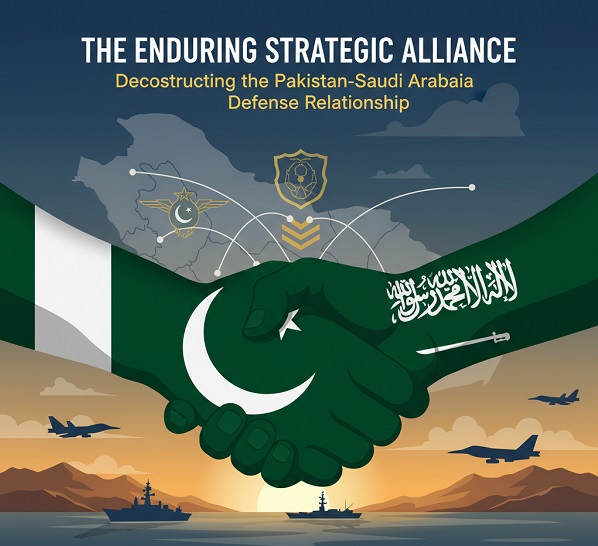
The relationship between Pakistan and Saudi Arabia is one of the most enduring and strategically significant in the Muslim world. Built upon shared religious bonds, mutual economic interests, and a convergence of security priorities, their defence cooperation has often functioned as an implicit, yet profoundly deep, defense pact for decades.
While formal, explicit mutual defense treaties are rare, the functional reality of their strategic alignment often overshadows any single written document.
A History Forged in Security and Solidarity
The roots of this defence relationship extend back to the 1960s, establishing a foundational arrangement where Pakistan assumed the role of a trusted security provider and partner for the Kingdom. This cooperation has traditionally involved three core pillars:
1. Manpower and Training: Pakistan’s highly trained military has historically deployed thousands of personnel to Saudi Arabia in training, advisory, and internal security roles. Pakistani military expertise has been instrumental in training the Saudi armed forces, a relationship formalized through agreements dating back to the 1980s.
2. Security of the Kingdom: At critical junctures, Pakistan has provided assurances—and personnel—for the defence of Saudi territory and the two Holy Mosques. This commitment has been tested during major regional crises, solidifying Pakistan’s status as a key guarantor of Saudi stability.
3. Financial Patronage: In exchange, Saudi Arabia has consistently provided vital economic and financial support to Pakistan, often extending crucial oil credits and financial assistance during Islamabad’s periods of economic distress. This financial underpinning has been essential to maintaining the close strategic alignment.
The Elephant in the Room: Nuclear Ambiguity
The most speculated-upon aspect of the Pakistan-Saudi defense relationship is the potential for a “nuclear umbrella.” As the only Muslim-majority nuclear power, Pakistan’s strategic assets inherently introduce a layer of deterrence that is of immense value to its allies. While both nations have consistently denied any formal sharing of nuclear technology or operational control, the persistent and intentional ambiguity surrounding this topic serves a strategic purpose. For Riyadh, this relationship acts as an existential deterrent against major regional threats. For Islamabad, it elevates its geopolitical profile and guarantees continued financial and political patronage from the oil-rich Kingdom. The understanding remains unspoken: an existential threat to Saudi Arabia would likely elicit a security response from Pakistan that goes beyond conventional means, giving the alliance a strategic depth few others in the region possess.
Drivers for Formalization
In an era of shifting global dynamics and increasing regional instability, the continuous discussion of formalizing the defense pact—potentially with a collective security clause—is driven by several factors:
● Regional Threats: The need for enhanced joint deterrence against shared adversaries, primarily in the wake of instability and rising non-state actor threats, drives the desire for a more formalized commitment.
● Diversifying Security: As major global powers realign their focus, Saudi Arabia seeks to diversify its security guarantees away from an over-reliance on a single Western partner, looking to reliable regional allies like Pakistan.
● Strategic Signaling: A formal pact would send an undeniable message to regional and global actors that an attack on one nation is a challenge to the collective strategic interests of both.
The Pakistan-Saudi defense relationship is not defined by a single document, but by a deep-seated, reciprocal commitment to mutual security. It is an alliance rooted in history and powered by geopolitical necessity, where Pakistan offers military muscle and strategic deterrence, and Saudi Arabia provides critical financial and diplomatic support—a tacit but potent strategic axis that continues to shape the geopolitics of the Middle East and South Asia.